Interactive Installation · Dubai Airshow 2025
EDGE
A physical-digital installation that let defence professionals explore the HT-750 helicopter through a motorised sliding screen and touch interface — simulating a live scan of the aircraft at Dubai Airshow 2025.
Year
2025
Company
Eventagrate
Role
Interactive & UX Designer
Tools
Ventuz, Figma, Blender
Overview
EDGE Group — one of the UAE's leading advanced technology groups — needed an interactive installation to showcase the HT-750 helicopter at Dubai Airshow 2025, attended by 135,000+ industry professionals. The installation combined a physical helicopter model, a motorised sliding screen, and a touchscreen: as visitors select a section of the aircraft, the screen physically moves to that part and displays technical information — simulating a live scan of the helicopter.

The challenge
The sliding screen moved physically via OSC signals, but the helicopter model's exact dimensions weren't available during development. Rather than hardcoding stop positions, I exposed all positional values as editable parameters in Ventuz scene data — so the on-site tech team could calibrate each stop in real-time without rebuilding the application.
My Role
I was the sole designer on the sliding screen application at Eventagrate — responsible for the full scope from interaction logic to visual design to iconography.
This included:
Designing the information architecture across 5 stops and 7 sub-components
Building the complete interaction logic in Ventuz, including OSC value exposure for on-site calibration
Designing all UI elements and custom icons in Figma
Editing 3D models in Blender to match EDGE's visual standards
Coordinating feedback with the Interactive Producer and PM across 3 major iteration rounds
Information Architecture
The installation mapped the HT-750 across 5 navigable stops. The key IA decision was grouping complex sub-components into two expandable categories rather than listing everything at the top level — matching how defence buyers think about the aircraft by function, not by part name.
Tail · Exhaust · Fuel Tank — single-tap stops revealing specs and isolating that section of the model
Payload (expandable) — Optical, Lidar, Close Cargo, Open Cargo, Flotation Device
POD (expandable) — Passengers, Stretcher
Selecting any sub-component triggered the outer shell to open and reveal the internal part with a smooth transition.

Exploration & Iterations
Three major iteration rounds shaped the final experience:


Outcome
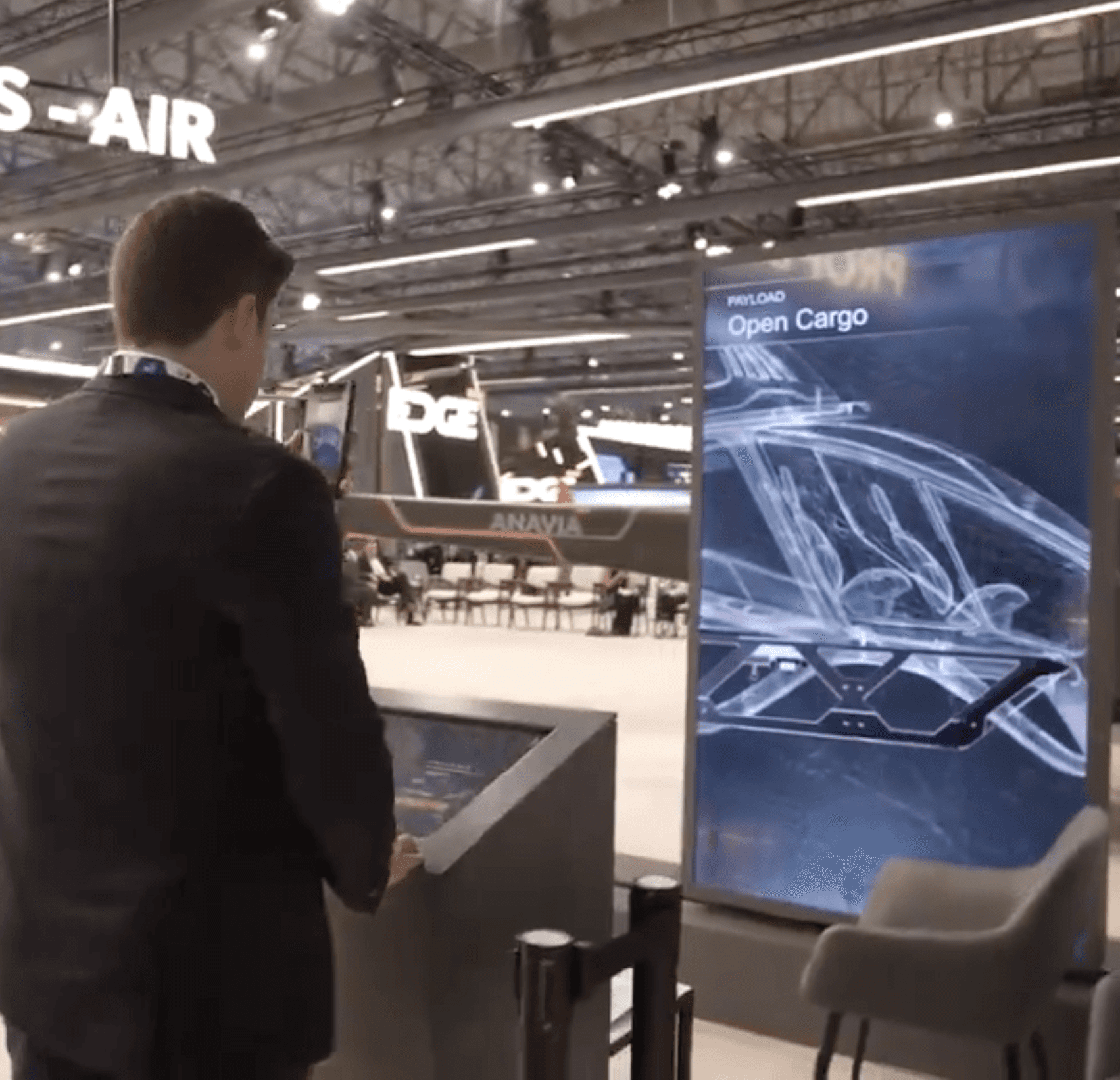
Exhibited at Dubai Airshow 2025, Dubai South. The installation ran with EDGE representatives guiding visitors while the touchscreen allowed independent exploration. The client was satisfied across all delivered applications — the project led directly to a continued collaboration. The work was cited positively in a formal KPI review.
Designed for and tested at exhibition scale
Zero-instruction interaction — users understood it immediately
Real-time rendering maintained across full session length
Reflection
The most interesting design problem here wasn't visual — it was systemic. When you can't know a physical dimension in advance, you design for adaptability instead of precision. Exposing the OSC values as editable parameters meant the experience stayed precise and adjustable without requiring a developer on-site for every calibration. It's the kind of decision that's invisible when it works — but the whole installation depends on it.